How DWC (Double Wall Corrugated) Pipes Improve Drainage and Underground Piping Solutions
DWC pipes pair a corrugated outer wall for load-bearing ring stiffness with a smooth inner bore for flow efficiency, outperforming concrete and metal on weight, corrosion resistance and installation speed.
In today’s infrastructure landscape, DWC (Double Wall Corrugated) pipes have transformed underground piping and drainage systems. Known for their strength, flexibility and longevity, these pipes are manufactured using advanced corrugation technology. At the forefront of this innovation is ITIB Machinery India Pvt. Ltd. – a trusted name in corrugated pipe manufacturing machinery, combining European engineering heritage with Indian manufacturing expertise.
Understanding DWC Pipes
What Are Double Wall Corrugated Pipes?
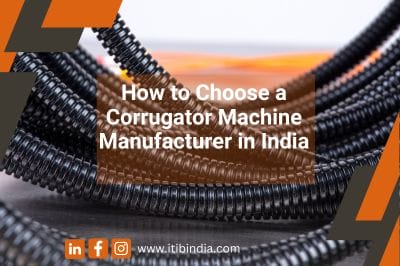
Double Wall Corrugated (DWC) pipes consist of two layers – an outer corrugated layer that provides structural rigidity, and an inner smooth layer that ensures efficient fluid flow. Produced on ITIB’s double wall corrugated pipe making machine, these pipes are designed for underground drainage, cable protection and stormwater management applications.
Made from HDPE, PP or PVC, DWC pipes offer an alternative to conventional concrete or metal pipes, with lower weight, chemical resistance and long service life.
Superior Material Properties for Longevity
DWC pipes produced on ITIB India’s machines exhibit strong mechanical performance and environmental resistance. The outer corrugated layer absorbs pressure from soil and vehicular loads, while the inner smooth wall allows faster water discharge.
The dual-wall configuration delivers:
- Fewer joints per running metre than short-section concrete pipe, reducing infiltration and exfiltration points
- Minimal maintenance requirements across the service life
- Long operational lifespan under buried conditions
These qualities make DWC pipes suitable for stormwater drainage, culverts and underground sewage networks.
Strength and Flexibility in Harsh Conditions
DWC pipes handle demanding environmental conditions – fluctuating temperatures, aggressive soil chemistry and groundwater pressure. The dual-layer construction provides flexibility without compromising structural stability.
Installed underground, DWC pipes accommodate dynamic loads from heavy vehicles, making them suitable for highway and urban drainage networks where the pipe-soil interaction carries the load.
Why DWC Pipes Suit Underground Drainage
Underground drainage networks require materials that withstand heavy loads, corrosion and environmental pressure. DWC pipes perform well across all four:
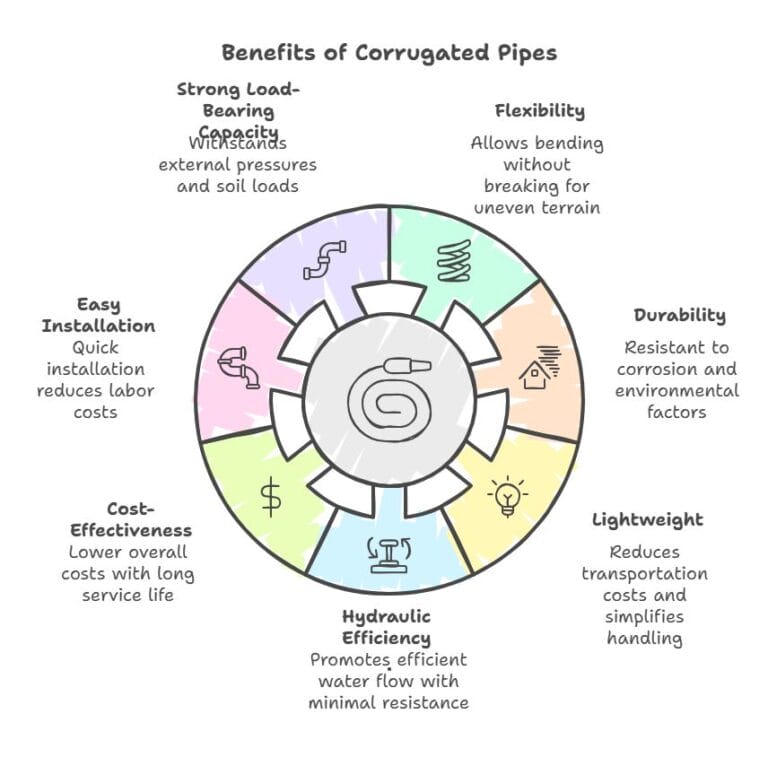
- High load-bearing strength – the corrugated exterior resists soil and traffic pressures through ring stiffness rather than wall mass.
- Smooth inner surface – maintains flow velocity and reduces solids deposition, lowering blockage frequency.
- Corrosion and abrasion resistance – thermoplastics are non-reactive with the sulphides and chlorides that attack concrete and metal.
- Easy installation – lightweight construction simplifies handling and reduces plant and labour requirements on site.
These advantages make DWC pipes a standard choice for municipalities, construction firms and infrastructure developers.
For a broader treatment of corrugated pipe in drainage duty, see advantages of corrugated pipes for drainage applications and the essential guide to DWC corrugated pipes and their applications.
ITIB India’s DWC Manufacturing Technology
At the heart of this capability is ITIB India’s DWC corrugator range – the Form 75 series. These machines process PE, PP, PVC, PA, EVA and other thermoplastics, serving industries from telecommunication ducts to sanitary pipelines.
The Form 75 Series: Verified Specifications
| Specification | Form 75-64 | Form 75-96 |
| Standard diameter (min. I.D.) | 30 mm | 15 mm |
| Standard diameter (max. O.D.) | 75 mm | 75 mm |
| Number of moulds | 64 | 96 |
| Chain length | 4,220 mm | 6,333 mm |
| Closing length | 1,400 mm | 2,550 mm |
| Maximum mechanical speed | 25 m/min | 25 m/min |
| PP output | 115 kg/hr ±10% | 260 kg/hr ±10% |
| HDPE output | 115 kg/hr ±10% | 115 kg/hr ±10% |
| Installed power | 5.5 kW | 5.5 kW |
| Machine weight (without mould) | 2,000 kg | 2,000 kg |
Choosing between them: both machines share the same footprint, installed power and top speed. The difference is the mould chain. The Form 75-96 carries 96 moulds against the 75-64’s 64, giving a longer forming zone – which is why it delivers 260 kg/hr in PP against 115 kg/hr, and why it reaches down to 15 mm I.D. rather than 30 mm. If your product mix is PP-heavy or includes smaller bores, the 75-96 is the machine. If you are running HDPE, both deliver 115 kg/hr and the 75-64 is the shorter, simpler line.
Utilities and Site Requirements
Both Form 75 models share the same service requirements:
| Parameter | Value |
| Voltage | 230-400 V, 50-60 Hz |
| Auxiliary circuit voltage | 24 VDC |
| Cooling water temperature (corrugator) | 8-10 °C |
| Cooling water temperature (mandrel) | 8-10 °C |
| Water consumption (corrugator) | 3,000 L/h at 3 bar |
| Water consumption (mandrel) | 1,500 L/h at 3 bar |
| Compressed air working pressure | 7 bar |
| Air consumption | 60 Nm³/h |
| Operating temperature range | 5-40 °C |
| Operating humidity (max.) | 95% |
| Vacuum pump (optional, V range) | 300 m³/h |
These are the figures to size your chiller, compressor and electrical supply against before the machine arrives. Undersized chiller capacity caps line speed regardless of the corrugator’s rating.
Output figures carry a ±10% tolerance. ITIB reserves the right to modify machine specifications without prior notice.
Precision Engineering by ITIB Machinery India Pvt. Ltd.
DWC pipe quality depends on dimensional consistency through the forming zone. The Form 75 series is built around precision-machined mould blocks and controlled cooling on both the corrugator and the mandrel, supporting:
- Uniform wall thickness across the corrugation profile
- Consistent pipe dimensions run to run
- Surface finish suitable for jointing systems
For critical shapes – small diameters and uneven profile diameters – a vacuum system holds profile accuracy during forming. It is available as an option on V-range machines at 300 m³/h pumping capacity.
Applications of DWC Pipes
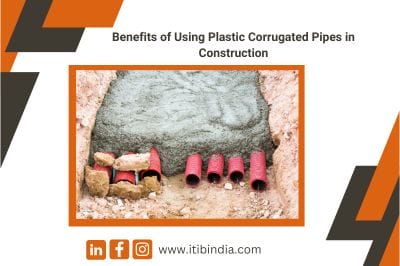
The versatility of DWC pipes extends beyond drainage. They are widely used in:
- Sewage and stormwater management – gravity mains and surface water collection
- Telecom cable protection – see telecom ducts for fibre optic cable ducting
- Underground electrical conduit systems – see electrical conduits
- Railway and road drainage – cross-drainage and formation drainage
- Industrial wastewater pipelines – where chemical resistance rules out metal
With ITIB India’s DWC corrugators, manufacturers can serve all of these sectors from one line.
DWC Pipes vs Traditional Materials
| Feature | DWC Pipes | Concrete / Metal Pipes |
| Weight | Lightweight – hand-placeable in small diameters | Heavy – requires lifting plant |
| Corrosion resistance | Non-reactive thermoplastics; unaffected by sulphides and chlorides | Concrete subject to sulphide attack; metal to corrosion |
| Joints per 100 m | Fewer – longer unit lengths | More – short unit lengths increase infiltration points |
| Hydraulic performance | Smooth bore maintains flow velocity | Surface roughens over service life |
| Installation time | Fast – lower plant and labour requirement | Slower – lifting and bedding intensive |
| Handling damage risk | Ductile; resists impact during handling | Brittle; chipping and cracking on handling |
| Maintenance | Minimal – periodic inspection and jetting | Higher – joint remediation and surface repair |
DWC pipes offer clear advantages on weight, corrosion resistance, joint count and installation speed. Design life for buried pipe of any material depends on installation quality, bedding and service conditions, and should be assessed against the specific project rather than assumed from the material alone.
Installation, Maintenance and Sustainability
Ease of Installation and Maintenance
Because DWC pipes are lightweight and flexible, they can be installed with less plant and fewer personnel than equivalent concrete sections. Push-fit and coupler joint systems make assembly faster and reduce joint leakage.
This translates to shorter project timelines and lower maintenance costs – a factor for municipal drainage, telecom networks and industrial projects alike.
Sustainability Benefits
DWC pipes contribute to sustainability through:
- Recyclable materials – HDPE and PP are both recyclable thermoplastics
- Lower transport emissions – reduced weight per metre lowers haulage load
- Reduced repair frequency – fewer interventions over service life means lower lifetime impact
Integration with ITIB’s Turnkey Projects
ITIB India supplies complete systems, not standalone machines. Turnkey scope covers:
- Consultation and needs assessment
- Plant layout design
- Equipment supply – extruder to coiler, with warranty coverage
- Installation and commissioning
- Operator training
- After-sales support, spare parts supply and process optimisation
See the corrugated pipe production line page for full turnkey scope, or the complete turnkey solution for single wall and double wall corrugated pipes guide for a component-by-component breakdown.
DWC Pipes in Modern Infrastructure
Across India, DWC pipes have become integral to urban drainage programmes, stormwater management and fibre optic cable protection. Their adaptability to varying soil conditions and ease of jointing make them a reliable component of modern utility networks – which is what drives sustained demand for the machinery that produces them.
Why Choose ITIB Machinery India Pvt. Ltd.
Choosing ITIB India means:
- European engineering heritage – as part of the global ITIB Group, machines designed in collaboration with ITIB’s international R&D centres
- 50+ years of corrugator experience – over five decades of extrusion line engineering
- Local manufacturing and support – Mumbai-based operations with an Indian service network
- Customisable production lines – configured to your diameter range, material and output requirements
- Complete range under one roof – single wall and double wall corrugators plus coilers, from one supplier
- After-sales support – technical support, spare parts supply and process optimisation assistance
ITIB’s expertise covers both single wall and double wall corrugators. For pipe below the DWC range, see the single wall corrugated pipe making machine range, which handles 4.5 mm I.D. up to 65 mm O.D.
Ready to specify a DWC line? Contact India’s trusted corrugator machine manufacturer at sales@itibindia.com or +91-22-62231691 / +91-96191-40918, or use our contact form.
Frequently Asked Questions
What is a double wall corrugated pipe?
A double wall corrugated (DWC) pipe has a corrugated outer wall that provides ring stiffness and a smooth inner wall that maintains flow efficiency. It is used for underground drainage, stormwater management, cable protection and sewage networks.
What pipe diameters can ITIB DWC corrugators produce?
The Form 75-64 produces pipes from 30 mm I.D. up to 75 mm O.D. The Form 75-96 produces pipes from 15 mm I.D. up to 75 mm O.D.
What is the output rate of an ITIB DWC corrugator?
The Form 75-64 produces up to 115 kg/hr in both PP and HDPE. The Form 75-96 produces up to 260 kg/hr in PP and 115 kg/hr in HDPE. Both figures carry a ±10% tolerance.
What is the difference between the Form 75-64 and Form 75-96?
Both machines share the same footprint, 5.5 kW installed power and 25 m/min maximum speed. The Form 75-96 carries 96 moulds against the 75-64’s 64, giving a longer forming zone – resulting in higher PP output and a lower minimum diameter.
What materials can DWC corrugators process?
ITIB DWC corrugators process PE, PP, PVC, PA, EVA and other thermoplastic materials.
What utilities does a Form 75 corrugator require?
Both Form 75 models require 230-400 V at 50–60 Hz, cooling water at 8-10 °C (3,000 L/h corrugator, 1,500 L/h mandrel, both at 3 bar), and compressed air at 7 bar with 60 Nm³/h consumption.
Why are DWC pipes preferred over concrete for underground drainage?
DWC pipes are lighter to handle and install, resist the sulphide and chloride attack that degrades concrete, use fewer joints per 100 m, and maintain hydraulic performance through a smooth inner bore.