Advantages of Corrugated Pipes for Drainage Applications
Corrugated pipes offer flexibility, corrosion resistance, low weight, high ring stiffness and fast installation – delivering reliable drainage at lower installed cost than concrete or metal alternatives.
Corrugated pipes have become a preferred choice for drainage applications due to their unique design and material benefits. The corrugation itself is the engineering feature: folding the wall into a repeating profile builds ring stiffness from geometry rather than wall thickness, so the pipe resists soil and traffic loads while staying light and flexible.
Below are the seven advantages that make corrugated pipe an efficient solution for stormwater management, sewage systems and agricultural drainage – with the mechanism behind each, and a note on whether it applies to single wall pipe, double wall pipe, or both.

Single Wall vs Double Wall: Why the Distinction Matters
Not every advantage below applies equally to both corrugated pipe types, and specifying the wrong one is a common and expensive error.
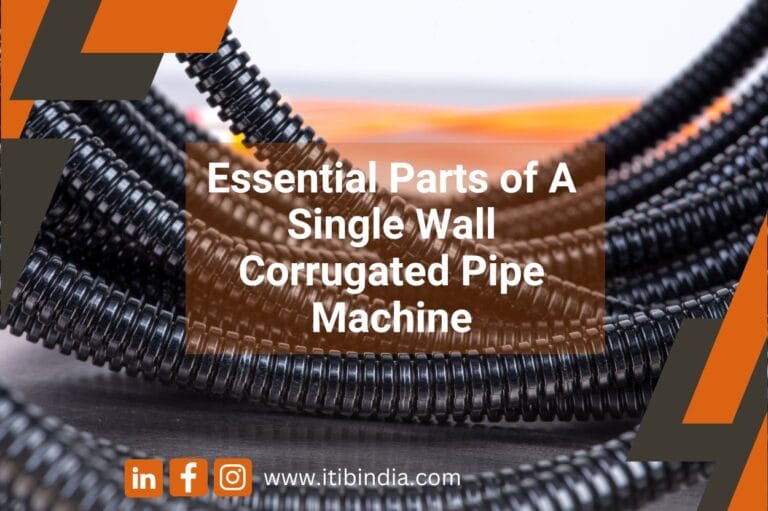
Single wall corrugated pipe is corrugated on both the inside and outside. The bore follows the corrugation profile. It is highly flexible, coilable, and suited to subsoil drainage, perforated land drains, cable protection and conduit duty.
Double wall corrugated (DWC) pipe has a corrugated outer wall and a separate smooth inner wall. It sacrifices some flexibility for hydraulic performance, which makes it the standard for gravity sewer and stormwater mains.
The practical consequence: if the duty involves conveying flow with solids, the smooth bore of DWC is not optional. If the duty is subsoil collection or cable protection, single wall is lighter, cheaper and easier to install.
1. Flexibility
The corrugated structure allows these pipes to bend without breaking, making them suitable for installation in uneven terrain or areas with shifting ground. Where a rigid concrete section would crack under differential settlement, a corrugated pipe deflects and recovers.
Mechanism: the corrugation acts as a series of hinge points along the pipe axis, distributing bending strain across many folds rather than concentrating it at one location.
Applies to: both, more so to single wall. Single wall pipe is flexible enough to be coiled; DWC is supplied in straight lengths and offers deflection tolerance rather than true flexibility.
2. Durability
Manufactured from high-quality materials such as high-density polyethylene (HDPE), polypropylene (PP) or PVC, corrugated pipes resist corrosion, chemical attack and environmental degradation.
Mechanism: thermoplastics are chemically non-reactive with the sulphides and chlorides that attack concrete and corrode metal. There is no electrochemical corrosion pathway and no cement matrix to degrade.
On service life: buried pipe design life depends on installation quality, bedding, backfill compaction and service conditions – not on material alone. A well-installed thermoplastic drainage pipe delivers a long service life, but the figure should be assessed against the specific project and the applicable standard rather than assumed from the material.
Applies to: both equally. Material resistance is a property of the polymer, not the wall configuration.
3. Lightweight
Compared to traditional drainage pipes, corrugated pipes are significantly lighter. This reduces transport costs and simplifies handling during installation.
Mechanism: ring stiffness comes from the corrugation geometry rather than wall mass, so the pipe achieves its structural rating with far less material than a solid-wall equivalent.
Practical effect: small-diameter corrugated pipe can often be placed by hand. Concrete sections of equivalent bore require lifting plant, which means crane hire, a larger working corridor and more traffic management on urban sites.
Applies to: both. DWC is heavier than single wall of the same bore, but both remain far lighter than concrete or metal.
4. Hydraulic Efficiency
This is where the two pipe types diverge sharply, and where specification errors are most common.
Double wall corrugated pipe combines a corrugated outer structure with a smooth inner surface. The smooth bore maintains flow velocity and limits solids deposition, which is why DWC is specified for gravity sewer and stormwater duty.
Single wall corrugated pipe has a corrugated bore. Flow resistance is higher and solids deposition is more likely, which is why single wall is used for subsoil collection, perforated land drainage and conduit duty rather than for conveying wastewater.
Specify accordingly: a smooth inner bore is a DWC property. Do not assume it from the phrase “corrugated pipe.”
Applies to: double wall.
5. Cost-Effectiveness
Corrugated pipes offer a lower overall installed cost through reduced material consumption, lower transport cost and faster installation. Long service life adds to the economic case.
Mechanism: the saving compounds across three stages. Less polymer per metre lowers material cost; lower weight lowers haulage cost per metre delivered; faster placement lowers labour and plant cost per metre laid.
Where it is most pronounced: long runs in open ground, where installation rate dominates project cost. In short, heavily obstructed urban runs the advantage narrows because excavation, not pipe handling, is the constraint.
Applies to: both.
6. Easy Installation
Lightweight construction and flexibility allow faster installation, reducing labour costs and shortening project timelines. This matters most on large-scale municipal and agricultural drainage schemes.
Mechanism: longer unit lengths mean fewer joints per 100 m, and each joint is a push-fit or coupler connection rather than a mortared or welded one. Fewer joints means faster laying and fewer potential infiltration points.
Applies to: both. Single wall pipe supplied in coils eliminates most joints entirely on subsoil runs.
7. Strong Load-Bearing Capacity
The corrugated design enhances structural strength, allowing these pipes to withstand external pressure and soil loads – suitable for both shallow and deeper buried installations.
Mechanism: the corrugation profile increases the second moment of area of the pipe wall, raising ring stiffness without adding wall thickness. This is the same principle that makes corrugated sheet stiffer than flat sheet of identical mass.
Critical caveat: flexible pipe carries load through pipe-soil interaction, not wall strength alone. The compacted bedding and haunch backfill are structural components of the installation. Poor compaction is the most common cause of flexible pipe deflection failure, and no amount of ring stiffness compensates for it.
Applies to: both. DWC generally achieves higher ring stiffness classes for equivalent bore.
Advantages Summary by Pipe Type
| Advantage | Single Wall | Double Wall (DWC) |
| Flexibility | High – coilable | Moderate – straight lengths |
| Corrosion and chemical resistance | Yes | Yes |
| Lightweight vs concrete | Yes | Yes |
| Smooth bore / hydraulic efficiency | No – corrugated bore | Yes |
| Low installed cost | Yes | Yes |
| Fast installation | Yes – fewest joints when coiled | Yes |
| Ring stiffness | Good | Higher classes available |
| Typical duty | Subsoil drainage, land drains, cable protection, conduit | Gravity sewer, stormwater mains, culverts |
Manufacturing Corrugated Pipe
Every advantage above traces back to the corrugation profile, and that profile is formed by the corrugator – the machine that determines wall consistency, dimensional accuracy and corrugation geometry.
ITIB Machinery India Pvt. Ltd. is a Mumbai-based corrugator machine manufacturer, part of the global ITIB Group, with over five decades of extrusion line engineering:
- Single wall corrugated pipe making machines – pipes from 4.5 mm I.D. up to 65 mm O.D.
- Double wall corrugated pipe making machines – pipes from 15 mm I.D. up to 75 mm O.D.
- Materials – PE, PP, PVC, PA, EVA and other thermoplastics
ITIB builds dedicated lines tuned to end-use specifications for electrical conduits, telecom ducts and sanitary pipes, and supplies complete corrugated pipe production lines from extruder to coiler.
Related reading
- How DWC pipes improve drainage and underground piping solutions
- The essential guide to DWC corrugated pipes and their applications
- Benefits of using plastic corrugated pipes in construction
- The role of corrugated pipes in Indian sewage systems
Planning corrugated pipe production? Email sales@itibindia.com or call +91-22-62231691 / +91-96191-40918, or use our contact form.
Frequently Asked Questions
What are the main advantages of corrugated pipes for drainage?
Corrugated pipes offer flexibility on uneven ground, corrosion and chemical resistance, low weight, high ring stiffness from the corrugation geometry, fast installation with fewer joints, and lower installed cost than concrete or metal.
Do corrugated pipes have a smooth inner surface?
Only double wall corrugated (DWC) pipes do. Single wall corrugated pipe is corrugated on both the inside and outside, so its bore follows the corrugation profile. The smooth inner wall is a DWC property.
Which is better for drainage, single wall or double wall corrugated pipe?
It depends on duty. Double wall is specified for gravity sewer and stormwater mains because the smooth bore maintains flow velocity and limits solids deposition. Single wall is preferred for subsoil drainage, perforated land drains, cable protection and conduit duty, where flexibility and low cost matter more than hydraulic performance.
Why are corrugated pipes stronger than their weight suggests?
The corrugation profile increases the second moment of area of the pipe wall, raising ring stiffness without adding wall thickness – the same principle that makes corrugated sheet stiffer than flat sheet of the same mass.
What materials are corrugated drainage pipes made from?
Most corrugated drainage pipes are produced from high-density polyethylene (HDPE), polypropylene (PP) or PVC. ITIB corrugators also process PA, EVA and other thermoplastics.
Does installation quality affect corrugated pipe performance?
Yes, significantly. Flexible pipe carries load through pipe-soil interaction, so compacted bedding and haunch backfill are structural components of the installation. Poor compaction is the most common cause of deflection failure.