The Role of Corrugated Pipes in Indian Sewage Systems
Corrugated pipes serve Indian sewage networks as stormwater drains, subsoil drainage, culverts and wastewater conveyance lines – offering flexibility, corrosion resistance, lighter weight and lower installed cost than concrete or metal.
Corrugated pipes have become a crucial component of modern sewage systems, particularly in India. Their versatility, durability and cost-effectiveness make them a practical choice for the extensive and complex drainage networks required across both urban and rural areas. Behind every one of those pipes sits an extrusion line – and the specification of that line determines pipe quality, output rate and unit economics for the manufacturer supplying the project.
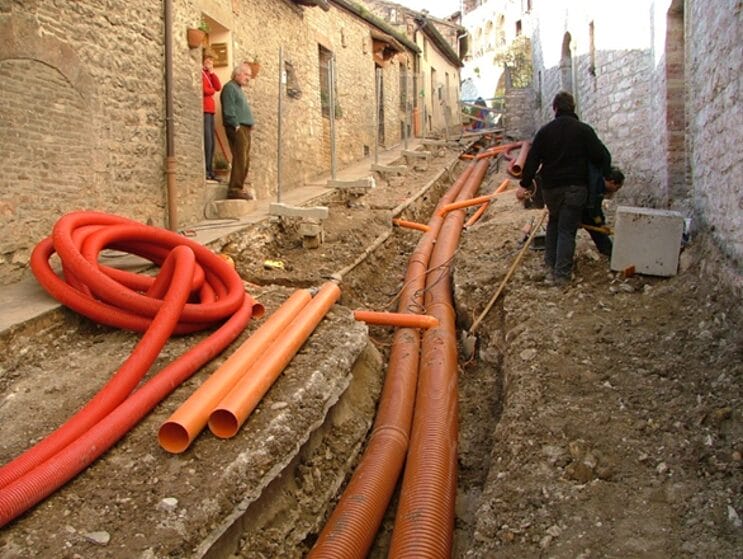
Advantages of Corrugated Pipes
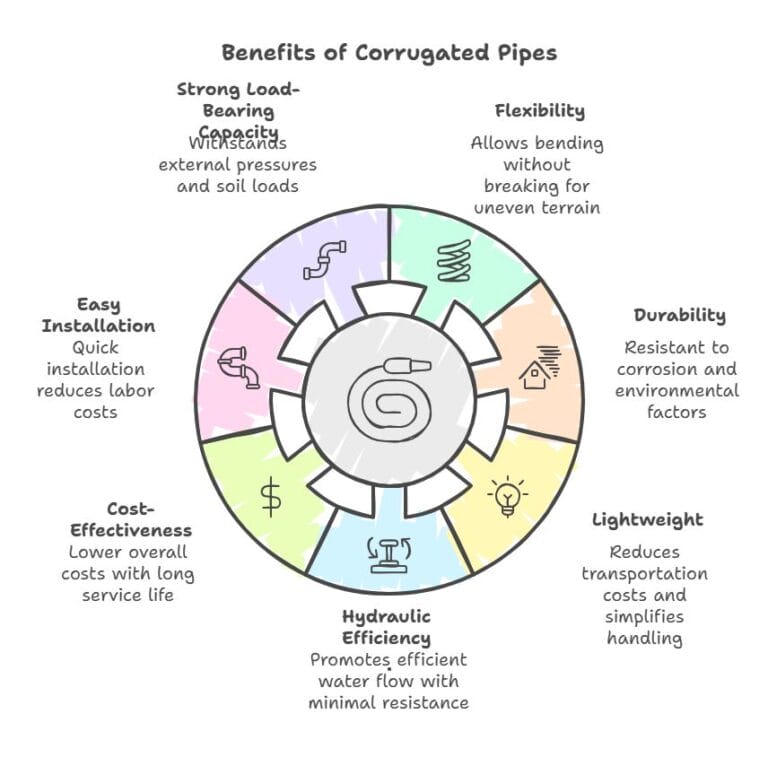
Corrugated pipes offer several benefits over traditional piping materials:
- Flexibility: The corrugated profile allows the pipe to bend and route around obstacles without compromising structural integrity – valuable in congested urban subsurface conditions.
- Strength and durability: Manufactured from high-density polyethylene (HDPE), polypropylene (PP) or PVC, corrugated pipes resist crush loading and aggressive soil chemistry that degrades concrete and corrodes metal.
- Lightweight: Substantially easier to transport, handle and install than concrete or metal equivalents, reducing plant and labour requirements on site.
- Cost-effectiveness: Lower installed cost and minimal maintenance across a long service life.
- Environmental benefits: Thermoplastic materials are recyclable, and reduced repair frequency lowers lifetime environmental impact.
- Leak resistance: Fewer joints per running metre than short-section concrete pipe means fewer infiltration and exfiltration points in the network.
Applications in Indian Sewage Systems
Corrugated pipes are used across several distinct duties within Indian sewage and drainage management:
- Stormwater drainage: Manages high-volume monsoon runoff and reduces urban flood risk.
- Wastewater conveyance: Transports effluent from residential, commercial and industrial areas toward treatment plants.
- Subsoil drainage: Lowers water table and prevents waterlogging in agricultural land and landscaped urban zones.
- Culverts and cross-drainage: Carries water beneath roads and rail formations, protecting the structural integrity of the formation above.
- Building and plot-level drainage: Small-diameter perforated and non-perforated corrugated pipe handles roof runoff, plot drainage and sanitary connections feeding into the trunk network.
- Cable and utility protection: The same corrugated geometry protects power, telecom and fibre optic ducting routed alongside sewage corridors.
Single Wall vs Double Wall in Drainage Duty
The two corrugator types serve different points in the network.
Single wall corrugated pipe has a uniform corrugated profile inside and out. It is flexible, coilable and well suited to subsoil drainage, perforated land drains, plot-level drainage, sanitary pipe and electrical conduit applications. Production runs on a single wall corrugated pipe making machine.
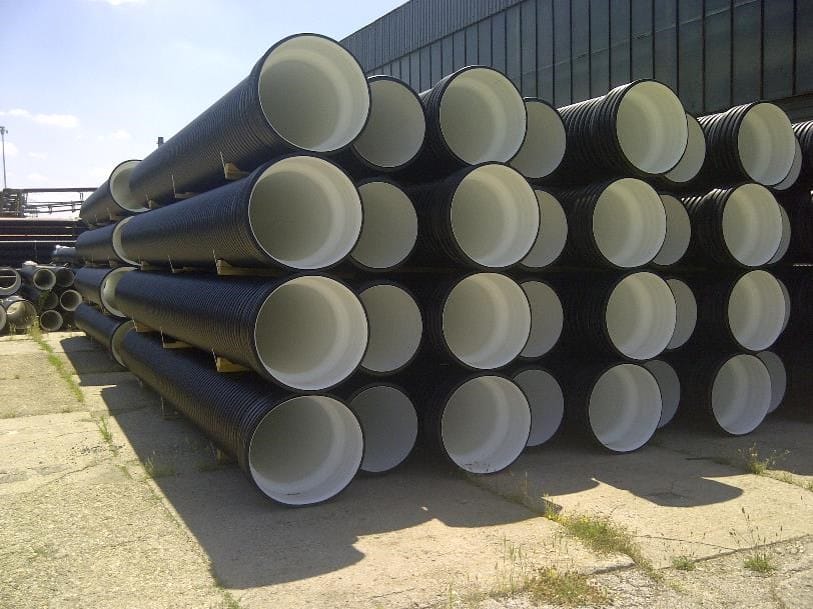
Double wall corrugated (DWC) pipe combines a corrugated outer wall for ring stiffness with a smooth inner bore for hydraulic efficiency. That smooth bore is what makes DWC the standard for gravity sewer and stormwater duty – flow velocity is higher and solids deposition is lower than in a fully corrugated bore. Production runs on a double wall corrugated pipe making machine.
For a fuller treatment of DWC performance in buried applications, see how DWC pipes improve drainage and underground piping solutions.
Installation and Maintenance
The installation sequence for corrugated pipe is straightforward:
- Site preparation: Clear and level the corridor where the pipes will be laid.
- Trenching: Excavate to the required depth, maintaining the design gradient for gravity-assisted flow.
- Bedding: Place and compact granular bedding to provide uniform support along the full pipe length.
- Laying the pipes: Position the pipes in the trench and connect using couplers, socket-and-spigot joints or electrofusion fittings as specified.
- Backfilling: Backfill in compacted layers around the haunch and over the crown to develop the soil-pipe interaction the design depends on.
Maintenance is minimal – typically periodic inspection and jetting to clear deposition. The smooth inner bore of DWC pipe reduces the frequency at which that intervention is needed.
Where Corrugated Pipes Are Deployed Across Indian Cities
Corrugated pipe is specified across a range of Indian infrastructure contexts:
- Dense coastal metros: Cities with high monsoon intensity and constrained subsurface corridors use corrugated stormwater drainage because the pipe routes around existing utilities without custom fittings.
- Expanding urban peripheries: Fast-growing peri-urban development uses corrugated wastewater conveyance to extend sanitation networks ahead of permanent trunk infrastructure.
- Agricultural and peri-agricultural zones: Perforated single wall subsoil drainage manages waterlogging and improves soil stability on cultivated land.
- Highway and rail corridors: Corrugated culvert and cross-drainage pipe carries flow beneath formations where light weight and rapid installation shorten possession windows.
Note: these are typical deployment contexts for the pipe type, not project references for ITIB India.
Comparison with Traditional Pipes
| Feature | Corrugated Pipes (HDPE / PP / PVC) | Traditional Pipes (Concrete / Metal) |
| Flexibility | High — routes around obstructions | Low — requires fittings and bends |
| Strength | Durable, corrosion-resistant | Strong but prone to corrosion or cracking |
| Weight | Lightweight | Heavy — needs lifting plant |
| Joints | Fewer per running metre | More joints, more infiltration points |
| Hydraulic performance | High (smooth bore on DWC) | Degrades as surface roughens with age |
| Cost | Lower installation and maintenance cost | Higher installation and maintenance cost |
| Environmental impact | Recyclable, lower footprint | Higher embodied carbon and footprint |
What This Means for Pipe Manufacturers
Demand across these applications is met by pipe extruders, and the constraint on that supply is line capability. A manufacturer entering the small-diameter drainage, subsoil, sanitary and conduit segment needs a corrugator matched to the diameter band it intends to serve, the thermoplastic it will run and the output rate its order book requires.
ITIB India’s equipment addresses that segment specifically:
- Single wall corrugators – pipes from 4.5 mm I.D. up to 65 mm O.D.
- Double wall corrugators – pipes from 40 mm O.D. up to 75 mm O.D.
- Materials – PE, PP, PVC, PA, EVA and other thermoplastics
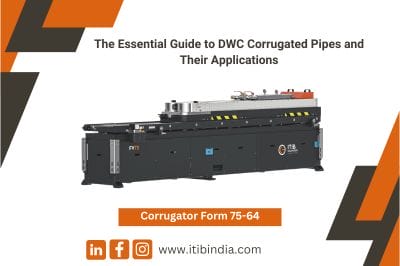
Representative models include the Form 15-110 single wall corrugator and the Form 75-64 double wall corrugator. Downstream, coilers handle winding for flexible small-diameter pipe.
This is the small-diameter end of the drainage and conduit market – plot drainage, subsoil drains, sanitary connections, cable protection and building services. Large-bore municipal trunk sewers sit outside this diameter band.
Choose ITIB India for Corrugators
ITIB Machinery India Pvt. Ltd. is a corrugator machine manufacturer based in Mumbai, part of ITIB Machinery International, with over five decades of engineering experience in extrusion lines for single and double wall corrugated pipe.
We supply complete turnkey solutions for single wall and double wall corrugated pipes – extrusion line, corrugator, downstream equipment, installation, commissioning, operator training and after-sales support.
Ready to specify a line? Email sales@itibindia.com or call +91-22-62231691 / +91-96191-40918, or use our contact form.
Frequently Asked Questions
Are corrugated pipes suitable for sewage systems in India?
Yes. Corrugated pipes are widely used in Indian sewage and drainage networks for stormwater drainage, wastewater conveyance, subsoil drainage and cross-drainage culverts. Their corrosion resistance and flexibility suit varied soil and monsoon conditions.
What is the difference between single wall and double wall corrugated pipe for drainage?
Single wall corrugated pipe is corrugated inside and out, is flexible and coilable, and suits subsoil drainage, land drains and conduit duty. Double wall corrugated pipe has a corrugated outer wall for ring stiffness and a smooth inner bore for hydraulic efficiency, making it the standard for gravity sewer and stormwater lines.
What material are corrugated sewage pipes made from?
Most corrugated drainage and sewage pipes in India are produced from high-density polyethylene (HDPE), polypropylene (PP) or PVC. ITIB corrugators also run PA, EVA and other thermoplastics.
What pipe diameters can ITIB corrugator machines produce?
ITIB single wall corrugators produce pipes from 4.5 mm I.D. up to 65 mm O.D. ITIB double wall corrugators produce pipes from 40 mm O.D. up to 75 mm O.D.
Does ITIB India provide installation and operator training?
Yes. ITIB India provides complete installation, commissioning, operator training and after-sales support as part of its turnkey and support services.
Where is ITIB India located?
ITIB Machinery India Pvt. Ltd. has its registered office at 2A, Court Chambers, 35 New Marine Lines, Mumbai 400 020, an administrative office in Ghatkopar (East), Mumbai, and a warehouse in Bhiwandi, Maharashtra.