Electrical Conduit Pipe Making Machine: Complete Line Specification Guide
Introduction
An electrical conduit pipe making machine is a corrugated pipe extrusion line configured for one output: flexible conduit that protects electrical cable. India’s conduit demand runs across residential wiring, industrial cable management, automotive harness and optical fibre ducting — and each of those pulls a different diameter and a different material. This guide covers how the line is configured, what diameter range is realistic, and which corrugator machine model matches your product.
1. What an electrical conduit pipe making machine produces
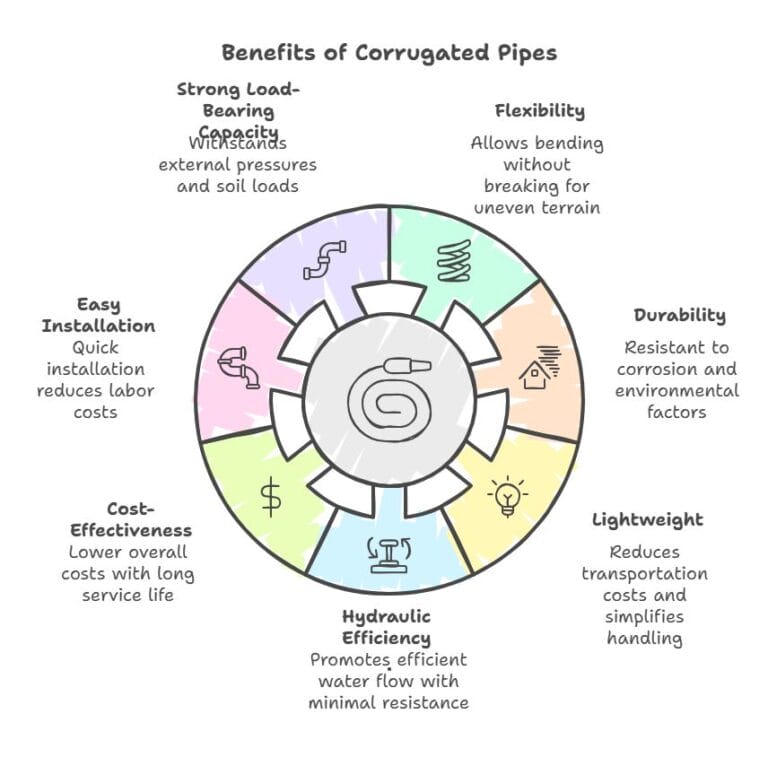
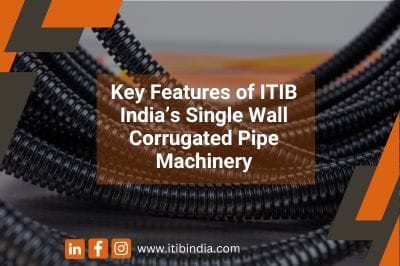
A conduit line produces flexible, fully corrugated single-layer pipe. The corrugated profile is what gives conduit its two defining properties: it bends without kinking, and it resists crush loads at a fraction of the wall thickness a smooth-wall pipe would need. That makes it the standard for cable protection in walls, floors, ducts and vehicle harness routing. ITIB supplies complete lines for electrical conduits from 16 mm O.D. up to 63 mm O.D.
The same platform, with different tooling, produces the adjacent product families:
● Telecom ducts — long-length protection for optical fibre cable installation.
● Harness pipes — automotive cable protection from 4.5 mm I.D. up to 63 mm O.D., built to German and Japanese OEM specifications.
● Medical tubes — with or without cuff, in normal or collapsible corrugation.
● Sanitary pipes and washing machine pipes — waste and appliance inlet/outlet tubing.
2. Line configuration: what a complete conduit line contains
A conduit machine is not one unit. ITIB supplies the conduit line as an integrated sequence:
● Raw material feeding — meters resin into the line.
● Hopper drier — removes moisture before extrusion; non-negotiable for hygroscopic materials.
● Extruder — melts and homogenises the polymer.
● Die head — forms the melt into the initial tube profile.
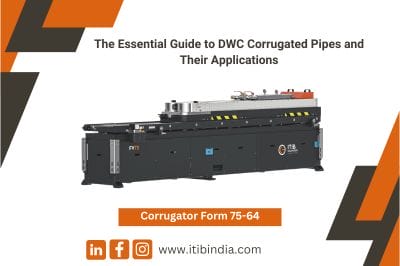
● Corrugator — the mould-chain unit that forms the corrugation. This is the component that defines the product.
● Dies and moulds — sized per conduit dimension, changed for each diameter you produce.
● Manual winders — collect the finished conduit into coils.
The throughput of the slowest stage sets the throughput of the line, which is why buying a corrugator in isolation and integrating it against an existing extruder frequently disappoints. The corrugated pipe production line is engineered as one balanced system; the component-level breakdown is in the corrugated pipe production line equipment guide.
3. Diameter range and model selection
Conduit sizing drives model choice. ITIB single wall corrugators cover 4.5 mm I.D. up to 65 mm O.D., which spans the entire 16–63 mm conduit range. Match your product to the model:
| Form model | Pipe range | Moulds | Max speed | Typical conduit fit |
| Form 15-70 | 4.5 mm I.D. – 15 mm O.D. | 70 | 40 m/min | Micro-duct, small harness tubing |
| Form 15-110 | 4.5 mm I.D. – 15 mm O.D. | 110 | 40 m/min | Same range, higher output via longer mould chain |
| Form 32-52/72 | 10 mm I.D. – 32 mm O.D. | 52 (ext. 72) | 35 m/min | 16–32 mm electrical conduit — the volume sizes |
| Form 32-72/92 | 10 mm I.D. – 32 mm O.D. | 72 (ext. 92) | 35 m/min | Same range at higher throughput |
| Form 65-54/74 | 10 mm I.D. – 65 mm O.D. | 54 (ext. 74) | 27 m/min | 32–63 mm conduit and larger telecom duct |
Read the table on mould count, not just diameter. Form 15-70 and Form 15-110 make the same pipe; the 110-mould chain delivers roughly 60% more throughput because the pipe spends longer in the cooled mould. The same logic applies between Form 32-52/72 and Form 32-72/92.
4. Material selection and its effect on output
ITIB conduit lines process PE, PP, PVC, PA and EVA. Material is not a neutral choice — it changes rated output on the same machine by a wide margin:
| Model | PVC (kg/hr) | PP (kg/hr) | HDPE (kg/hr) |
| Form 15-70 | 33 | 23 | 23 |
| Form 15-110 | 53 | 35 | 35 |
| Form 32-52/72 | 115 | 65 | 65 |
| Form 32-72/92 | 150 | 80 | 80 |
| Form 65-54/74 | 140 | 80 | 80 |
All figures are ±10% and depend on material, pipe diameter, ambient temperature, pipe profile and extruder capacity. PVC runs roughly 1.75–1.9 times the throughput of PP or HDPE on the same corrugator — a decisive factor when you are modelling plant capacity. The full comparison is in PVC vs PP vs HDPE for corrugated pipe production.
5. Utilities, footprint and installation requirements
Scope these before the line arrives, not after:
| Requirement | Form 32 series | Form 65-54/74 |
| Machine length | 2,200 mm (32-52/72) / 2,800 mm (32-72/92) | 2,300 mm |
| Machine width | 1,000 mm | 1,200 mm |
| Minimum height | 1,200 mm | 1,200 mm |
| Weight (without mould) | 1,200 kg / 1,400 kg | 1,350 kg |
| Installed power | 4.0 kW | 3.0 kW |
| Electrical supply | 230–400 V, 50–60 Hz, 24 V DC auxiliary | 230–400 V, 50–60 Hz, 24 V DC auxiliary |
| Chilled water | 3,000 L/H at 6–8 °C | 3,000 L/H at 6–8 °C |
| Compressed air | 40 Nm³/h at 7 bar | 60 Nm³/h at 7 bar |
| Extrusion axis height | 1,050 ±20 mm | 1,050 ±20 mm |
| Ambient conditions | 5–40 °C, max 95% RH | 5–40 °C, max 95% RH |
Note the extrusion axis height of 1,050 ±20 mm across the single wall range — it fixes the mounting height of your extruder and downstream equipment, and it is the most commonly missed item in a plant layout drawn before the machine is specified.
6. Single wall or double wall for conduit?
For electrical conduit the answer is single wall. Conduit needs flexibility and a fully corrugated profile, which is exactly what a single wall corrugator machine produces. A double wall corrugator makes twin-wall pipe with a smooth bore and a corrugated outer wall from 40 mm to 75 mm O.D. — engineered for underground drainage and sewerage, where ring stiffness and flow matter more than bend radius.
Producers serving both conduit and drainage markets standardise on one supplier across both families. The single wall vs double wall comparison sets out where the line splits, and the advantages of corrugated pipes for drainage applications covers the drainage side of the product mix.
7. Buying the line: turnkey versus component sourcing
A conduit plant sourced component by component leaves you owning the integration risk — mismatched throughput, tooling that does not match the die, and no single party accountable for line performance. ITIB supplies conduit lines as a complete turnkey solution: plant layout design, equipment supply, installation, commissioning and operator training.
Evaluation criteria for the supplier itself — manufacturing depth, diameter coverage, material versatility and after-sales support — are set out in how to choose a corrugator machine manufacturer in India. Once the line is running, the corrugator machine maintenance schedule protects the output you paid for.
and CTA
Scope a conduit line in this order: product diameter, material, target output, then model. Getting that sequence right is what stops a plant from being capacity-limited on day one. ITIB Machinery India Pvt. Ltd. supplies complete electrical conduit lines from 16 mm to 63 mm O.D. as part of its wider corrugator machine manufacturing range. For a line specification against your product mix, contact ITIB India at sales@itibindia.com or +91 96191 40918.
FAQ
What diameter range can an electrical conduit pipe making machine produce?
ITIB supplies complete electrical conduit lines producing pipe from 16 mm O.D. up to 63 mm O.D. The underlying single wall corrugator range covers 4.5 mm I.D. to 65 mm O.D.
What equipment is included in a conduit production line?
Raw material feeding, hopper drier, extruder, die head, corrugator, dies and moulds for each dimension, and manual winders.
Which material gives the highest output on a conduit line?
PVC. On a Form 32-72/92 the rated output is 150 kg/hr on PVC against 80 kg/hr on PP or HDPE, both ±10% and dependent on diameter, profile, ambient temperature and extruder capacity.
Do I need a single wall or double wall machine for electrical conduit?
Single wall. Conduit requires a flexible, fully corrugated profile. Double wall corrugators produce smooth-bore twin-wall pipe from 40 to 75 mm O.D. for drainage and sewerage.