Corrugator Machine Maintenance: Preventive Schedule and Troubleshooting Guide
Introduction
Corrugator machine maintenance is what separates a line that hits its rated output from one that quietly loses hours every week. A corrugator machine is a continuous-motion assembly — a mould chain running against a die head under vacuum or blow pressure — and every one of those interfaces is a wear point. This guide sets out the preventive maintenance intervals that matter, the operating envelope your machine has to stay inside, and the defect-to-cause mapping that shortens fault-finding on the shop floor.
1. Why corrugator maintenance decides your effective output
Rated output on a datasheet is a theoretical figure. Actual output is rated output minus unplanned stoppages, minus scrap from out-of-spec pipe, minus the slow drift in line speed operators accept when the machine stops running cleanly.
On a mould-chain corrugator the loss is rarely dramatic. It shows up as a half-metre-per-minute reduction here, a rejected coil there. Across a shift running a single wall corrugated pipe making machine at 35–40 m/min, that compounds into real tonnage. Preventive maintenance is cheaper than the recovery, and it is the one variable fully inside your control once the line is commissioned.
2. The wear points on a mould-chain corrugator
Maintenance attention follows the load path. On ITIB Form-series corrugators the components that carry continuous mechanical, thermal and vacuum load are:
● Mould blocks and mould chain — the machines carry 52 to 110 mould blocks depending on model, all cycling continuously. Cavity surfaces, guide rails and chain pins are the primary wear items.
● Die head and tooling interface — polymer residue and thermal cycling degrade the seal between die and mould entry. See the essential parts of a single wall corrugated pipe machine for the component breakdown.
● Cooling water circuit — scaling and biofilm reduce heat transfer before they trigger any alarm. Form-series single wall models draw 2,000–3,000 L/H; double wall models draw 3,000 L/H on the corrugator plus 1,500 L/H on the mandrel.
● Compressed air system — the range runs on a 7 bar working pressure with consumption from 15 to 60 Nm³/h. Pressure drop and moisture carry-over both distort corrugation formation.
● Vacuum pump (V range, optional) — rated 150/175 to 300 m³/h across the range. Seal wear reduces forming pressure gradually and silently.
● Downstream haul-off and winders — tension drift on the coiler distorts pipe that left the corrugator in spec.
3. Daily maintenance checks
These are start-of-shift checks. None require tools and all of them protect the mould chain, which is the most expensive item on the machine.
● Chilled water inlet temperature and flow — confirm against the model datasheet before the line is loaded.
● Compressed air line pressure at 7 bar, with the moisture trap drained.
● Visual inspection of mould block faces for polymer residue, scoring or carbon build-up.
● Mould chain tension and running noise — snatching or irregular pitch sound is an early indication of guide or pin wear.
● Vacuum reading (V-range machines) at steady state, logged so drift is visible over time rather than discovered at failure.
● First-off pipe check: outer diameter, corrugation pitch and wall thickness against the production spec.
● Ambient conditions inside the machine envelope — the Form range is specified for 5–40 °C and a maximum 95% relative humidity.
4. Weekly and monthly maintenance
Weekly
● Deep-clean mould cavities. Residue in the cavity transfers directly to corrugation geometry.
● Lubricate the mould chain per the machine manual — under-lubrication accelerates pin wear, over-lubrication contaminates pipe.
● Inspect and clean cooling water strainers and check for scaling at the return line.
● Verify electrical terminations. The Form range runs 230–400 V at 50–60 Hz with a 24 V DC auxiliary circuit; loose auxiliary terminations cause intermittent faults that read as control problems.
Monthly / quarterly
● Mould block dimensional check on a sample set — cavity wear shows as gradual loss of corrugation depth long before pipe fails inspection.
● Chain wear measurement against manufacturer limits; plan chain replacement against production schedule rather than against failure.
● Vacuum pump service, including seal and oil condition where applicable.
● Full cooling circuit flush and water quality test.
● Alignment check between extruder, die head and corrugator entry — misalignment loads one side of the mould chain.
Where the line was supplied as a complete turnkey solution, schedule these against the upstream extruder and hopper drier service intervals so the whole line takes one planned stoppage rather than three.
5. Operating parameters that must stay in spec
Most corrugator faults are a parameter that drifted out of range, not a component that broke. The published operating envelope for the ITIB Form range:
| Parameter | Single wall Form models | Double wall Form 75-64 / 75-96 |
| Cooling water temperature | 6–8 °C | 8–10 °C (corrugator and mandrel) |
| Water consumption | 2,000–3,000 L/H | 3,000 L/H corrugator + 1,500 L/H mandrel (3 bar) |
| Air working pressure | 7 bar | 7 bar |
| Air consumption | 15–60 Nm³/h | 60 Nm³/h |
| Installed power | 1.5–4.0 kW | 5.5 kW |
| Supply | 230–400 V, 50–60 Hz, 24 V DC auxiliary | 230–400 V, 50–60 Hz, 24 V DC auxiliary |
| Ambient temperature | 5–40 °C | 5–40 °C |
| Relative humidity (max) | 95% | 95% |
| Maximum mechanical speed | 27–40 m/min by model | 25 m/min |
| Vacuum pump (optional, V range) | 150/175–250 m³/h | 300 m³/h |
Log these daily. A trend line across two weeks identifies a developing fault that a single spot reading never will. Full parameter sets for each model are on the individual datasheet pages — Form 15-70, Form 15-110, Form 32-52/72, Form 32-72/92, Form 65-54/74, Form 75-64 and Form 75-96.
6. Troubleshooting: defect to machine-side cause
This mapping covers the faults most often traced back to the corrugator rather than to the extruder or the resin. Confirm against your machine manual before intervening.
| Pipe defect | Likely machine-side cause | First action |
| Shallow or inconsistent corrugation depth | Vacuum loss, worn mould cavity, poor mould-to-die seal | Log vacuum at steady state; inspect cavity faces on a sample of blocks |
| Ovality in finished pipe | Uneven cooling, water temperature above spec, downstream haul-off tension | Check chilled water inlet temperature and both sides of the cooling circuit |
| Wall thickness variation around circumference | Die-to-corrugator misalignment, uneven melt distribution | Run alignment check between die head and mould chain entry |
| Surface marks or drag lines | Residue in mould cavity, chain lubricant carry-over | Deep-clean cavities; review lubrication quantity and interval |
| Pitch irregularity along the pipe | Mould chain tension, worn chain pins or guides | Measure chain wear against manufacturer limits |
| Pipe sticking in the mould | Cooling too slow, cavity surface condition, incorrect melt temperature | Verify water flow and temperature before adjusting extruder settings |
| Output falling below rated kg/hr | Line speed reduced by operators to compensate for another fault | Treat as a symptom — audit the parameter log rather than raising speed |
7. Where single wall and double wall maintenance differ
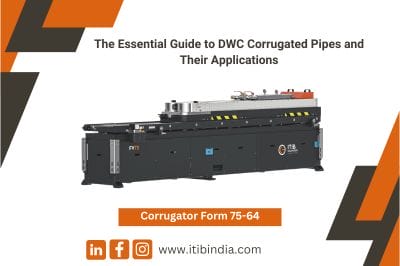
A double wall corrugated pipe making machine adds a mandrel and an inner-layer forming stage that single wall machines do not have. That creates two maintenance obligations unique to DWC lines: a second cooling circuit at 1,500 L/H on the mandrel, and inspection of the bond zone where the smooth inner wall meets the corrugated outer wall. A defect there shows up as delamination in service, not as a visible fault at the machine.
DWC corrugators also run at a lower maximum mechanical speed — 25 m/min against up to 40 m/min on the smaller single wall models — and at a higher installed power of 5.5 kW. If you run both families in one plant, do not assume a common service interval. The differences between single wall and double wall corrugated pipe machines extend to how they wear.
8. Spares, tooling and manufacturer support
Two spares decisions determine how long an unplanned stoppage lasts:
● Consumable and wear spares held on site — chain components, seals, filters and gaskets. These should never be the reason a line is down.
● Tooling strategy — dies and moulds are sized per pipe dimension. Producers running several diameters should hold changeover tooling rather than treating each change as a lead-time event.
Beyond spares, the practical question is whether your supplier can support the machine over its service life. That is a selection criterion, not an afterthought — it is covered in detail in how to choose a corrugator machine manufacturer in India. As a corrugator machine manufacturer with more than five decades of engineering experience as part of the global ITIB Group, ITIB Machinery India Pvt. Ltd. supports the full corrugator machine range from tooling through to line commissioning.
and CTA
Maintenance on a corrugator is not complicated, but it is unforgiving of drift. Log the operating parameters daily, protect the mould chain, and treat a falling output figure as a symptom to investigate rather than a number to compensate for. For machine documentation, tooling or service support on any ITIB Form-series corrugator, contact ITIB Machinery India at sales@itibindia.com or +91-22-62231691.
FAQ block (FAQPage JSON-LD source)
How often should a corrugator machine be serviced?
Run daily start-of-shift checks on water temperature, air pressure, mould condition and vacuum; weekly cavity cleaning and chain lubrication; and a monthly or quarterly dimensional and wear inspection. Always follow the interval published in your machine manual, which takes precedence over any general schedule.
What are the most common corrugator machine faults?
Inconsistent corrugation depth from vacuum loss or cavity wear, pipe ovality from cooling problems, pitch irregularity from mould chain wear, and surface marking from cavity residue.
What cooling water temperature does a corrugator need?
ITIB single wall Form models are specified for 6–8 °C; double wall Form 75-64 and 75-96 are specified for 8–10 °C on both the corrugator and the mandrel circuits.
Does mould chain wear affect pipe quality before the chain fails?
Yes. Corrugation pitch irregularity and depth loss appear well before mechanical failure, which is why sample dimensional checks on mould blocks belong in the monthly schedule.