What Is a Corrugators Machine? Types, Working Principle and Applications
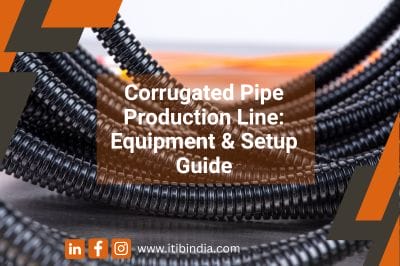
A corrugators machine is an extrusion forming machine that converts a continuous molten thermoplastic tube into a ridged, ring-profiled pipe by drawing it through two closing chains of water-cooled mould blocks. The corrugator sits immediately after the extruder and die head in a plastic pipe line and is the unit that actually creates the corrugation profile – the alternating crest-and-valley geometry that gives corrugated pipe its flexibility, crush resistance and low weight per metre.
ITIB Machinery India Pvt. Ltd. has been building corrugators for the plastic pipe industry for over five decades as part of ITIB Machinery International, with a product range covering small-diameter pipe from 4.5 mm I.D. up to 75 mm O.D.
What a corrugators machine is – and what it is not
The word “corrugator” is used for two completely different classes of machine, and mixing them up is the single most common source of confusion when buyers start researching.
| Machine class | What it processes | What it produces | Output form |
| Plastic pipe corrugator (this article) | Molten thermoplastic from an extruder — PVC, PP, HDPE, PA, EVA | Corrugated pipe and tube with a ring or spiral profile | Continuous pipe, coiled or cut to length |
| Paper / board corrugator | Kraft paper reels and starch adhesive | Corrugated fibreboard sheet for cartons | Flat board sheet |
Everything below refers to the plastic pipe corrugators machine. A plastic pipe corrugator does not make sheet, board or cartons; it makes pipe and tube.
Within plastic pipe machinery, “corrugators machine”, “corrugator equipment” and “corrugated pipe machine” are used interchangeably in the market. Strictly, the corrugator is one unit inside a larger line – see corrugated pipe production line capacity planning for how the units combine.
How a corrugators machine works: the forming cycle
The forming cycle is mechanically simple and repeats continuously as the pipe is drawn forward.
- Plasticising. The extruder melts and homogenises the thermoplastic and delivers it at controlled temperature and pressure.
- Tube formation. The die head shapes the melt into a continuous parison – a hot, soft tube. In a double wall machine the die head produces two concentric flows: the outer corrugated layer and the inner smooth layer.
- Mould block closing. Two opposing chains of mould blocks – the mould chain – close around the parison. Each mould block carries the negative of the corrugation profile.
- Forming. The soft tube is pressed into the mould cavity. Vacuum applied through the mould blocks pulls the melt against the cavity wall, which is what produces sharp, repeatable crests. On ITIB machines a vacuum pump is offered as an option on the V-range with a pumping speed of 300 m³/h — critical for small diameters and for uneven profile diameters where shape retention is difficult.
- Cooling. The blocks are water-cooled while closed. ITIB single wall corrugators specify a water temperature of 6–8 °C; double wall models specify 8–10 °C on both the corrugator and mandrel circuits. The pipe must set hard enough to hold shape before the chain opens.
- Chain opening and return. The blocks separate, release the formed pipe and travel back along the chain to close again on fresh melt.
- Downstream handling. The finished pipe passes to a coiler or a cut-to-length station.
Two design parameters govern how much cooling time the pipe gets: chain length and closing length. On the ITIB range, chain length runs from 1,980 mm on the Form 15-70 to 6,333 mm on the double wall Form 75-96, with closing lengths from 700 mm to 2,550 mm. Longer closing length means more time under cooled mould contact at any given line speed.
Types of corrugators machine
Single wall corrugators
A single wall corrugator forms one corrugated wall. The pipe is flexible along its whole length, light, and easy to coil. It is the standard construction for electrical conduit, cable harness protection, appliance hose, medical tubing and small drainage.
ITIB’s single wall range – Form 15-70, Form 15-110, Form 32-52/72, Form 32-72/92 and Form 65-54/74 – covers 4.5 mm I.D. up to 65 mm O.D. Full specifications are on the single wall corrugated pipe making machine page.
Double wall corrugators
A double wall corrugator (DWC) forms a corrugated outer wall bonded to a smooth inner wall. The corrugated skin supplies ring stiffness; the smooth bore supplies hydraulic performance. DWC construction requires a mandrel and a second cooling circuit, which is why the double wall models carry higher installed power and a second water consumption figure.
ITIB’s double wall models are the Form 75-64 and Form 75-96. Specifications are on the double wall corrugated pipe making machine page.
For a side-by-side comparison of construction and behaviour, see single wall corrugator and double wall corrugator: understanding the features.
Corrugators machine specifications that actually matter
These are the figures to compare when evaluating any corrugator. The table below is drawn from ITIB India model datasheets. Output figures are theoretical and carry a ±10% tolerance; actual output depends on material, pipe diameter, ambient temperature, pipe profile and extruder capacity.
| Model | Wall type | Diameter range | Moulds | Installed power | PVC / PP / HDPE output (kg/hr ±10%) | Max. mechanical speed |
| Form 15-70 | Single | 4.5 mm I.D. – 15 mm O.D. | 70 | 1.5 kW | 33 / 23 / 23 | 40 m/min |
| Form 15-110 | Single | 4.5 mm I.D. – 15 mm O.D. | 110 | 1.5 kW | 53 / 35 / 35 | 40 m/min |
| Form 32-52/72 | Single | 10 mm I.D. – 32 mm O.D. | 52, extendable to 72 | 4.0 kW | 115 / 65 / 65 | 35 m/min |
| Form 32-72/92 | Single | 10 mm I.D. – 32 mm O.D. | 72, extendable to 92 | 4.0 kW | 150 / 80 / 80 | — |
| Form 65-54/74 | Single | 10 mm I.D. – 65 mm O.D. | 54, extendable to 74 | 3.0 kW | 140 / 80 / 80 | 27 m/min |
| Form 75-64 | Double | 30 mm I.D. – 75 mm O.D. | 64 | 5.5 kW | — / 115 / 115 | 25 m/min |
| Form 75-96 | Double | 15 mm I.D. – 75 mm O.D. | 96 | 5.5 kW | — / — / 115 | 25 m/min |
Reading the table:
- Mould count is a throughput lever, not a size lever. Form 15-70 and Form 15-110 form the same diameters. The 110-mould machine has a longer chain, so more of the pipe is under cooled mould contact at any instant, and PVC output rises from 33 to 53 kg/hr.
- Extendable mould chains protect the investment. The Form 32-52/72, Form 32-72/92 and Form 65-54/74 ship with a base mould count that can be extended later, so capacity can be raised without replacing the corrugator.
- Installed power is low across the range – 1.5 kW to 5.5 kW on the corrugator itself. Extruder and chiller loads dominate the total line demand, not the corrugator.
- Utility conditions are part of the specification. Operating temperature 5–40 °C, maximum operating humidity 95%, supply 230–400 V at 50–60 Hz, 24 V DC auxiliary circuit, 7 bar air system working pressure, and 60 Nm³/h air consumption on the double wall models.
Materials a corrugators machine can process
ITIB corrugator lines are built for a wide range of thermoplastics, including PE, PP, PVC, PA and EVA. The three that dominate commercial production are:
- PVC – highest output on the single wall range (up to 150 kg/hr ±10% on the Form 32-72/92). Standard for electrical conduit in the Indian market.
- PP – used where higher temperature resistance and better stress-crack behaviour matter, including appliance and automotive applications.
- HDPE – the standard for buried drainage, DWC and telecom duct. HDPE and PP share the same output rating across the ITIB range.
Material choice changes throughput, cooling demand and mould release behaviour, so datasheet output must always be read against the specific polymer.
Where corrugated pipe made on a corrugators machine is used
| Application | Typical wall type | ITIB reference page |
| Electrical conduit, 16–63 mm O.D. | Single wall | Electrical Conduits |
| Automotive cable harness protection, 4.5 mm I.D. – 63 mm O.D. | Single wall | Harness Pipes |
| Medical tubing, with or without cuff, normal to collapsible corrugation | Single wall | Medical Tubes |
| Washing machine inlet and outlet hose, OEM and replacement | Single wall | Washing Machine Pipes |
| Wash basin, sink and urinal waste pipe | Single wall | Sanitary Pipes |
| Optical fibre telecom duct | Single / double wall | Telecom Ducts |
| Subsoil and building drainage | Double wall | Advantages of corrugated pipes for drainage applications |
For the construction-side case, see benefits of using plastic corrugated pipes in construction.
How to match a corrugators machine to your product range
Work backwards from the pipe, not forwards from the machine.
- Fix the diameter envelope first. The largest O.D. you intend to sell sets the model family. A Form 15 series machine will not make 32 mm pipe regardless of mould count.
- Then fix the polymer. Read the output row for that polymer, not the headline figure.
- Then fix throughput. If the required kg/hr sits above the base model, choose an extendable-chain model and add moulds rather than buying a larger frame.
- Then check utilities. Chilled water at 6–8 °C (single wall) or 8–10 °C (double wall), 2,000–3,000 LT/H per circuit, plus 1,500 LT/H for the DWC mandrel circuit, and 7 bar compressed air.
- Then check the floor. Extrusion axis height is 1,050 ±20 mm on the single wall range and 1,160 ±20 mm on the double wall range — the extruder centreline must match.
- Then decide on vacuum. Small diameters and uneven profile diameters need the vacuum system to hold shape.
Machine-level selection criteria are covered in more depth in selecting the right single wall corrugator machine. Supplier-level criteria are covered in how to evaluate a corrugator machine manufacturer.
Frequently asked questions
What is a corrugators machine used for?
A corrugators machine forms corrugated plastic pipe and tube by pressing a molten thermoplastic parison into water-cooled mould blocks. The pipe it produces is used for electrical conduit, cable harness protection, medical tubing, appliance hose, sanitary waste pipe, telecom duct and drainage.
What is the difference between a single wall and a double wall corrugator?
A single wall corrugator forms one corrugated wall, giving a flexible, coilable pipe. A double wall corrugator forms a corrugated outer wall bonded to a smooth inner wall, adding ring stiffness and a smooth bore. Double wall machines need a mandrel and a second cooling circuit.
What diameter pipe can an ITIB corrugators machine produce?
The ITIB India range covers 4.5 mm I.D. up to 65 mm O.D. on single wall corrugators and up to 75 mm O.D. on double wall corrugators.
Which materials can a corrugators machine run?
ITIB corrugator lines handle a range of thermoplastics including PE, PP, PVC, PA and EVA. Output ratings differ by polymer — PVC gives the highest kg/hr on the single wall range.
Does mould count change the pipe size a corrugator can make?
No. Mould count changes throughput, not diameter. More moulds means a longer chain and more cooled contact time, which allows higher line speed at the same diameter.
Is a vacuum pump required on a corrugators machine?
It is offered as an option on the ITIB V-range with a pumping speed of 300 m³/h. Vacuum is recommended for small diameters and for uneven profile diameters, where the melt will not hold the cavity shape reliably without it.