Single Wall Corrugator Machine: Form 15, 32 and 65 Series Compared
ITIB India builds five single wall corrugator machines on three frame sizes. The frame sets the diameter ceiling – 15 mm, 32 mm or 65 mm O.D. – and the mould count within each frame sets output. Choose the frame from your largest pipe, then choose the mould count from your tonnage target. This guide compares all five Form models on published datasheet figures so you can shortlist in that order.
What a Single Wall Corrugator Machine Produces
A single wall corrugator machine forms one corrugated wall from the molten thermoplastic parison delivered by the extruder and die head. Two chains of water-cooled mould blocks close around the parison, the melt is formed into the cavity profile, cooled, and released as continuous pipe. The result is flexible, fully corrugated pipe that can be coiled – the construction used for electrical conduits, automotive harness pipes, medical tubes, washing machine pipes and sanitary pipes.
The forming cycle itself is covered in what is a corrugators machine. This article assumes that background and focuses on model selection within ITIB’s single wall corrugator machine range.
The Five ITIB Single Wall Models at a Glance
| Model | Workable diameters | Moulds | Chain length | Closing length | Max. speed | Installed power |
| Form 15-70 | 4.5 mm I.D. – 15 mm O.D. | 70 | 1,980 mm | 700 mm | 40 m/min | 1.5 kW |
| Form 15-110 | 4.5 mm I.D. – 15 mm O.D. | 110 | 3,110 mm | 1,250 mm | 40 m/min | 1.5 kW |
| Form 32-52/72 | 10 mm I.D. – 32 mm O.D. | 52 (ext. 72) | 2,940 mm | 790 mm | 35 m/min | 4.0 kW |
| Form 32-72/92 | 10 mm I.D. – 32 mm O.D. | 72 (ext. 92) | 4,071 mm | 1,355 mm | Not stated | 4.0 kW |
| Form 65-54/74 | 10 mm I.D. – 65 mm O.D. | 54 (ext. 74) | 3,053 mm | 790 mm | 27 m/min | 3.0 kW |
Source: ITIB India model datasheets. The Form 32-72/92 datasheet does not state a maximum mechanical speed.
The model names read directly: the first number is the maximum O.D. in millimetres, the second is the mould count. A Form 32-72/92 forms pipe up to 32 mm O.D. with 72 moulds, extendable to 92.
Step 1 – Filter by Diameter: Form 15, Form 32 or Form 65
Diameter is a hard limit. No mould count takes a Form 15 frame past 15 mm O.D., so the largest pipe in your product plan decides the series.
- Form 15 series (15-70, 15-110): 4.5 mm I.D. to 15 mm O.D. The only frames in the range that reach down to 4.5 mm I.D. – the small-bore end of harness and tubing work.
- Form 32 series (32-52/72, 32-72/92): 10 mm I.D. to 32 mm O.D. Covers the lower part of the 16–63 mm O.D. range served by an electrical conduit pipe making machine.
- Form 65 series (65-54/74): 10 mm I.D. to 65 mm O.D. The widest single wall envelope, reaching the 63 mm O.D. upper limit of ITIB’s conduit and harness pipe lines.
If any product in your three-year plan exceeds 65 mm O.D., it falls outside the single wall range and into the double wall corrugator machine family, which runs to 75 mm O.D.
Step 2 – Compare Output on Your Polymer, Not the Headline Figure
| Model | PVC (kg/hr) | PP (kg/hr) | HDPE (kg/hr) | PVC vs PP/HDPE |
| Form 15-70 | 33 | 23 | 23 | 1.43× |
| Form 15-110 | 53 | 35 | 35 | 1.51× |
| Form 32-52/72 | 115 | 65 | 65 | 1.77× |
| Form 32-72/92 | 150 | 80 | 80 | 1.88× |
| Form 65-54/74 | 140 | 80 | 80 | 1.75× |
Output figures are theoretical, carry a ±10% tolerance and depend on material, pipe diameter, ambient temperature, pipe profile and extruder capacity (ITIB India datasheets).
Three readings matter. First, PP and HDPE carry identical ratings on every single wall model, so between those two the choice turns on pipe properties, not machine capacity. Second, PVC runs faster on every frame, but the margin widens with frame size – about 1.4–1.5× on the Form 15 series against 1.75–1.9× on the Form 32 and Form 65 series. Third, no output is published for PA or EVA; confirm those with ITIB against your profile rather than extrapolating. The full material trade-off is in PVC vs PP vs HDPE on a corrugator machine.
Step 3 – Use Mould Count to Set Throughput
Within a frame, more moulds means a longer chain and a longer closing length – more time with the pipe held against cooled mould cavities at any line speed. That raises output; it does not change the diameters the machine can form.
| Pair (same diameter range) | Moulds | Closing length | PVC output | Change |
| Form 15-70 → Form 15-110 | 70 → 110 | 700 → 1,250 mm | 33 → 53 kg/hr | +61% |
| Form 32-52/72 → Form 32-72/92 | 52 → 72 | 790 → 1,355 mm | 115 → 150 kg/hr | +30% |
Both pairs share installed power – 1.5 kW on the Form 15 series, 4.0 kW on the Form 32 series – so the higher-mould model adds output without raising the corrugator’s own electrical load. The cost shows up in footprint and weight: the Form 15-110 is 550 mm longer and 120 kg heavier than the Form 15-70; the Form 32-72/92 is 600 mm longer and 200 kg heavier than the Form 32-52/72.
Step 4 – Plan for Growth with an Extendable Mould Chain
Three of the five models ship with a base mould count that can be extended later:
- Form 32-52/72: 52 moulds, extendable to 72.
- Form 32-72/92: 72 moulds, extendable to 92.
- Form 65-54/74: 54 moulds, extendable to 74.
The Form 15 series is fixed at 70 or 110 moulds. If you start in the 10–32 mm band and expect volume growth, an extendable Form 32 machine lets you add moulds rather than add a second corrugator. ITIB does not publish output at the extended mould counts – ask for those figures in writing at quotation stage rather than scaling the base rating. The kg/hr-to-metres conversion for your own pipe is set out in corrugated pipe production line capacity planning.
Step 5 – Check Utilities and Floor Space
| Model | L × W × min. H | Weight (no mould) | Chilled water | Compressed air | Vacuum (option) |
| Form 15-70 | 1,550 × 1,000 × 1,200 mm | 600 kg | 2,000 L/h | 15 Nm³/h | 150/175 m³/h |
| Form 15-110 | 2,100 × 1,000 × 1,200 mm | 720 kg | 2,500 L/h | 15 Nm³/h | 150/175 m³/h |
| Form 32-52/72 | 2,200 × 1,000 × 1,200 mm | 1,200 kg | 3,000 L/h | 40 Nm³/h | 200 m³/h |
| Form 32-72/92 | 2,800 × 1,000 × 1,200 mm | 1,400 kg | 3,000 L/h | 40 Nm³/h | 250 m³/h |
| Form 65-54/74 | 2,300 × 1,200 × 1,200 mm | 1,350 kg | 3,000 L/h | 60 Nm³/h | 250 m³/h |
Common to all five: extrusion axis height 1,050 ±20 mm, chilled water at 6–8 °C, compressed air at 7 bar, supply 230–400 V at 50–60 Hz with a 24 V DC auxiliary circuit, and an operating envelope of 5–40 °C at up to 95% relative humidity. The extrusion axis height fixes the centreline of your extruder and downstream equipment; ITIB coilers are built to an extrusion axis height of 1,100–1,150 mm, so check alignment when you lay out the line.
When to Specify the Vacuum (V Range) Option
Vacuum pulls the melt against the mould cavity so the corrugation holds its shape. ITIB recommends a vacuum system for critical shapes – small diameters and uneven profile diameters. It is optional on V-range machines, rated from 150/175 m³/h on the Form 15 series up to 250 m³/h on the Form 32-72/92 and Form 65-54/74. If your product mix sits at the small-bore end of the Form 15 range, budget for vacuum at purchase rather than retrofitting it.
Matching the Model to Your Product
| Product line | Size range published by ITIB | Single wall series that cover it |
| Electrical conduits | 16 mm O.D. – 63 mm O.D. | Form 32 (to 32 mm O.D.); Form 65 (to 65 mm O.D.) |
| Harness pipes | 4.5 mm I.D. – 63 mm O.D. | Form 15, Form 32 or Form 65 by size |
| Medical tubes | Not published – per product spec | Select by largest O.D. |
| Washing machine pipes | Not published – per product spec | Select by largest O.D. |
| Sanitary pipes | Not published – per product spec | Select by largest O.D. |
| Telecom ducts | Not published – per product spec | Select by largest O.D. |
Where ITIB does not publish a size range for an application, the selection logic does not change: take your largest O.D. to the diameter filter, then your polymer to the output table. Tubing-specific configuration is covered in corrugators for harness, medical and appliance tubing, and the full diameter map across single and double wall is in corrugated machine in India for small-diameter pipe.
Single Wall or Double Wall?
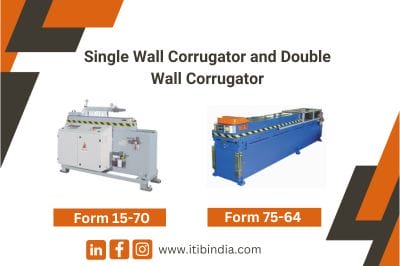
Choose single wall when the product has to bend, coil and protect cable or carry low-pressure waste: conduit, harness pipe, appliance hose, sanitary waste. Choose double wall when the pipe is buried and has to carry flow – a corrugated outer wall for ring stiffness bonded to a smooth inner bore. ITIB’s DWC models, Form 75-64 and Form 75-96, add a mandrel cooling circuit and run at 5.5 kW installed power. The side-by-side comparison is in corrugated pipe machine: single wall vs double wall.
A Five-Step Shortlist
- Fix the largest O.D. in your product plan – this selects Form 15, Form 32 or Form 65.
- Fix the polymer you will run in volume and read only that output column.
- Compare mould counts within the series against your kg/hr target, using the lower bound of the ±10% band.
- If volume will grow, prefer an extendable mould chain (Form 32 or Form 65 series).
- Confirm floor space, chilled water, compressed air and the 1,050 ±20 mm extrusion axis height against your plant before ordering.
Supplier-side checks – datasheet transparency, mould capability, spares – are covered in how to evaluate a corrugator machine manufacturer. For the full range from one corrugator machine manufacturer, including double wall models, see the corrugators machine overview.
Frequently Asked Questions
How many single wall corrugator machine models does ITIB India make?
Five: Form 15-70, Form 15-110, Form 32-52/72, Form 32-72/92 and Form 65-54/74. Together they cover pipe from 4.5 mm I.D. up to 65 mm O.D.
What is the difference between the Form 15-70 and Form 15-110?
Both form pipe from 4.5 mm I.D. to 15 mm O.D. on 1.5 kW installed power. The Form 15-110 carries 110 moulds against 70 and a 1,250 mm closing length against 700 mm, which raises rated PVC output from 33 to 53 kg/hr (±10%).
Which ITIB single wall corrugator has the highest output?
The Form 32-72/92, rated at 150 kg/hr on PVC and 80 kg/hr on PP or HDPE (±10%). For pipe above 32 mm O.D., the Form 65-54/74 is rated at 140 kg/hr on PVC.
Can I add moulds to a single wall corrugator later?
Yes, on three models: the Form 32-52/72 extends from 52 to 72 moulds, the Form 32-72/92 from 72 to 92 and the Form 65-54/74 from 54 to 74. The Form 15 series has a fixed mould count.
What utilities does a single wall corrugator machine need?
Chilled water at 6–8 °C (2,000–3,000 L/h depending on model), compressed air at 7 bar (15–60 Nm³/h), a 230–400 V, 50–60 Hz supply with a 24 V DC auxiliary circuit, and an extruder centreline matched to the 1,050 ±20 mm extrusion axis height.
Does a single wall corrugator need a vacuum pump?
Vacuum is an option on ITIB V-range machines and is recommended for small diameters and uneven profile diameters. Ratings run from 150/175 m³/h on the Form 15 series to 250 m³/h on the Form 32-72/92 and Form 65-54/74.
Talk to ITIB India
Shortlisting a single wall corrugator? Send ITIB India your largest pipe O.D., polymer and target output for a model recommendation and the full datasheet pack. Email sales@itibindia.com, call +91-22-62231691 or +91 96191 40918, or use the ITIB India contact form.