Corrugated Machine in India for Small-Diameter Pipe: A 4.5–75 mm Buyer’s Guide
Searches for a corrugated machine in India cover two different machines, and only one of them makes pipe. This guide covers the plastic pipe corrugator- specifically the small-diameter segment from 4.5 mm I.D. to 75 mm O.D., where conduit, harness pipe, tubing, telecom duct and plot-level drainage are produced. It maps diameter bands to ITIB India’s seven Form models, sets out what changes at small diameters, and lists what a complete line includes.
Which “Corrugated Machine” Do You Mean?
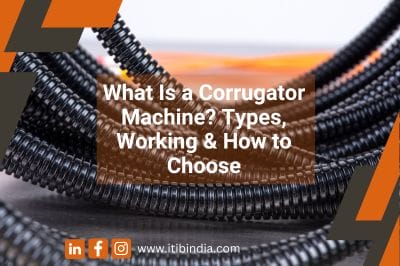
In the Indian market the phrase covers two unrelated machine classes. A board corrugator converts kraft paper reels into corrugated fibreboard for cartons. A plastic pipe corrugator takes molten thermoplastic from an extruder and forms it into ridged pipe inside a moving chain of water-cooled mould blocks. ITIB Machinery India Pvt. Ltd. manufactures the second: machines for corrugated pipes and tubes, not sheet or board. The side-by-side distinction is set out in what is a corrugators machine.
Why Small-Diameter Corrugated Pipe Is a Separate Segment
Large-bore municipal trunk sewers and small-bore conduit share a profile, not a market. Below 75 mm O.D. the end products are:
- Electrical conduits from 16 mm O.D. up to 63 mm O.D.
- Automotive harness pipes from 4.5 mm I.D. up to 63 mm O.D., built to German and Japanese OEM specifications.
- Medical tubes with or without cuff, in normal through to collapsible corrugation.
- Washing machine pipes– inlet and outlet pipe for OEM and replacement markets.
- Sanitary pipes for wash basin, kitchen sink and urinal waste.
- Telecom ducts for long-length optical fibre cable installation.
- Small-diameter drainage- plot drainage, subsoil drains and sanitary connections feeding the trunk network.
These products are typically made to a customer drawing and reward dimensional repeatability and fast changeover as much as raw tonnage. ITIB’s range is built for this end of the market; large-bore trunk sewers sit outside its diameter band.
The Four Diameter Bands and the Machines That Cover Them
| Band | Diameter envelope | Wall type | ITIB models | Products in band (ITIB pages) |
| A | 4.5 mm I.D. – 15 mm O.D. | Single | Form 15-70, Form 15-110 | Small-bore harness pipe and tubing |
| B | 10 mm I.D. – 32 mm O.D. | Single | Form 32-52/72, Form 32-72/92 | Electrical conduit from 16 mm O.D.; harness pipe |
| C | 10 mm I.D. – 65 mm O.D. | Single | Form 65-54/74 | Conduit and harness pipe up to 63 mm O.D. |
| D | 15 or 30 mm I.D. – 75 mm O.D. | Double (DWC) | Form 75-96 (from 15 mm I.D.), Form 75-64 (from 30 mm I.D.) | Small-diameter drainage, cable protection, telecom duct |
Diameters from ITIB India model datasheets.
The bands overlap deliberately. A 25 mm conduit can run on a Form 32 or a Form 65 frame: the Form 32-52/72 is rated to 35 m/min against 27 m/min on the Form 65-54/74, while the Form 65 gives headroom to 65 mm O.D. on the same machine. Which matters more depends on whether your product plan goes above 32 mm. A model-by-model comparison of bands A–C is in single wall corrugator machine: Form 15, 32 and 65 compared.
Single Wall or Double Wall at Small Diameters
Single wall pipe is corrugated inside and out. It is flexible, coilable and light- the construction for conduit, harness pipe, tubing and sanitary waste. Production runs on a single wall corrugated pipe making machine.
Double wall corrugated (DWC) pipe bonds a corrugated outer wall, which supplies ring stiffness, to a smooth inner bore, which maintains flow. It is the construction for buried drainage and cable protection. At small diameters, DWC starts at 15 mm I.D. on the Form 75-96 and 30 mm I.D. on the Form 75-64. Both run on a double wall corrugator machine platform with a second (mandrel) cooling circuit at 1,500 L/h and 3 bar, chilled water at 8–10 °C, an extrusion axis height of 1,160 ±20 mm and 5.5 kW installed power. Application detail is in how DWC pipes improve drainage and underground piping.
What Changes When the Pipe Gets Small
- Profile holding needs vacuum. ITIB specifies a vacuum system for critical shapes- small diameters and uneven profile diameters. Optional V-range ratings run from 150/175 m³/h (Form 15 series) and 200 m³/h (Form 32-52/72) to 250 m³/h (Form 32-72/92, Form 65-54/74) and 300 m³/h (Form 75 series).
- Cooling discipline tightens. Single wall machines run chilled water at 6–8 °C; DWC machines at 8–10 °C on both corrugator and mandrel circuits. Undersized chiller capacity caps line speed regardless of the corrugator’s rating.
- Line speed rises. The Form 15 series is rated to 40 m/min, the highest mechanical speed in the range, so downstream winding has to keep pace.
- Changeovers multiply. Dies and moulds are sized per pipe dimension. Producers serving several OEM sizes should hold changeover tooling rather than treat each size change as a lead-time event.
- Puller tension matters more. Thin-wall small-diameter pipe is where tension errors show first, as profile deformation.
Output Across the Small-Diameter Range
| Model | Band | PVC (kg/hr) | PP (kg/hr) | HDPE (kg/hr) | Max. speed |
| Form 15-70 | A | 33 | 23 | 23 | 40 m/min |
| Form 15-110 | A | 53 | 35 | 35 | 40 m/min |
| Form 32-52/72 | B | 115 | 65 | 65 | 35 m/min |
| Form 32-72/92 | B | 150 | 80 | 80 | Not stated |
| Form 65-54/74 | C | 140 | 80 | 80 | 27 m/min |
| Form 75-64 | D | — | 115 | 115 | 25 m/min |
| Form 75-96 | D | — | 260 | 115 | 25 m/min |
Output figures are theoretical, carry a ±10% tolerance and depend on material, pipe diameter, ambient temperature, pipe profile and extruder capacity (ITIB India datasheets). Double wall output is published for PP and HDPE only.
The Form 75-96 PP rating of 260 kg/hr is the highest figure in the range; confirm it against your profile at quotation. Polymer choice changes capacity on the same frame- see PVC vs PP vs HDPE on a corrugator machine– and converting kg/hr into running metres for your pipe is covered in corrugated pipe production line capacity planning.
Coiling Small-Diameter Pipe
Flexible small-diameter pipe leaves the line on a coiler. The published ITIB coiler specification:
| Parameter | Value |
| Standard pipe diameters | 6–60 mm |
| Winding width | 200–250 mm |
| Maximum winding speed | 300 rpm |
| External coil diameter (max.) | 650 mm |
| Internal coil diameter | 250 mm |
| Supply | 220 V single phase, 50 Hz |
| Extrusion axis height | 1,100–1,150 mm |
| Options | Connection to cutting machine; pipe-guide |
Two checks follow. If your product sits below 6 mm or above 60 mm, confirm the downstream configuration with ITIB, because those sizes fall outside the coiler’s standard range. And confirm the coiler’s axis height against the corrugator- 1,050 ±20 mm on single wall models, 1,160 ±20 mm on double wall.
What a Complete Corrugated Pipe Line Includes
A corrugator is the unit that defines the line, but it is not the line. A complete corrugated pipe production line runs in this sequence:
- Raw material feeding
- Hopper drier
- Extruder
- Die head
- Corrugator
- Dies and moulds, sized per pipe dimension
- Cooling, puller (haul-off) and coiler or winders
ITIB supplies this as a turnkey project: consultation and needs assessment, plant layout design, equipment supply, installation and commissioning, operator training, and after-sales support covering spare parts and process optimisation. ITIB Machinery India Pvt. Ltd. is part of the global ITIB Group, with more than five decades of corrugator engineering, a registered office in Mumbai, an administrative office in Ghatkopar (East) and a warehouse in Bhiwandi, Maharashtra. The equipment-by-equipment breakdown is in corrugated pipe production line: equipment and setup guide.
Questions to Put to Any Corrugated Pipes Machine Supplier in India
- Is output quoted per polymer, with a stated tolerance?
- What are the minimum I.D. and maximum O.D. for each model- from the datasheet, not the brochure?
- Is the mould chain extendable, and to how many moulds?
- Is a vacuum option available, and what is it rated at in m³/h?
- What extrusion axis height is the corrugator built to, and does the downstream equipment match?
- Are commissioning and operator training itemised in the quotation?
The full scoring framework is in how to evaluate a corrugator machine manufacturer, and the India-specific criteria are in how to choose a corrugator machine manufacturer in India. For ITIB’s range and credentials, see corrugator machine manufacturer in India.
Frequently Asked Questions
What is a corrugated machine used for in pipe manufacturing?
A plastic pipe corrugator forms molten thermoplastic into corrugated pipe inside a moving chain of water-cooled mould blocks. The pipe is used for electrical conduit, harness pipe, medical tubes, washing machine pipes, sanitary pipes, telecom ducts and drainage. It is a different machine from a board corrugator, which makes corrugated fibreboard.
What pipe sizes do ITIB corrugated pipe machines in India produce?
ITIB single wall corrugators produce pipe from 4.5 mm I.D. up to 65 mm O.D. Double wall corrugators produce pipe up to 75 mm O.D., from 15 mm I.D. on the Form 75-96 and 30 mm I.D. on the Form 75-64.
Which corrugated machine suits pipe below 15 mm O.D.?
The Form 15 series- Form 15-70 and Form 15-110- covering 4.5 mm I.D. to 15 mm O.D. The Form 15-110 is rated at 53 kg/hr on PVC against 33 kg/hr on the Form 15-70 (±10%). A vacuum option is available for small diameters and uneven profiles.
Does ITIB India make machines for corrugated plastic sheet?
No. ITIB India manufactures machines for corrugated pipes and tubes- single wall and double wall corrugators, coilers and complete production lines.
What materials can small-diameter corrugators process?
ITIB corrugators process PE, PP, PVC, PA and EVA. Rated output is published for PVC, PP and HDPE.
Where is ITIB India located?
ITIB Machinery India Pvt. Ltd. has its registered office at 2A, Court Chambers, 35 New Marine Lines, Mumbai 400 020, an administrative office in Ghatkopar (East), Mumbai, and a warehouse in Bhiwandi, Maharashtra.