Corrugators for Flexible Tubing: Harness, Medical, Washing Machine and Sanitary Pipe Lines
Automotive harness pipe, medical tubes, washing machine pipes and sanitary waste pipe are all made on single wall corrugators. Each product puts a different requirement on the line – an OEM dimensional specification, a hygiene requirement, a split between OEM and replacement demand, or a waste-fitting duty. This guide sets out how corrugators are configured for each tubing family, which ITIB Form models cover them, and what to settle before you specify a line.
Why Flexible Tubing Is Made on Corrugators
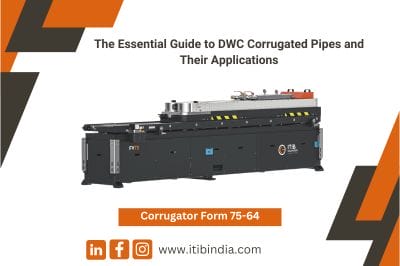
The corrugated profile lets a tube bend without kinking and resist crush loads at a thinner wall than smooth-wall tube needs. A single wall corrugator forms one corrugated wall that is flexible along its whole length and can be coiled. ITIB’s five single wall corrugators cover 4.5 mm I.D. to 65 mm O.D.; the model-by-model comparison is in single wall corrugator machine: Form 15, 32 and 65 compared. For how the forming cycle works, see what is a corrugators machine.
Automotive Harness Pipes
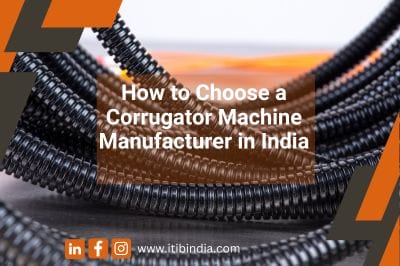
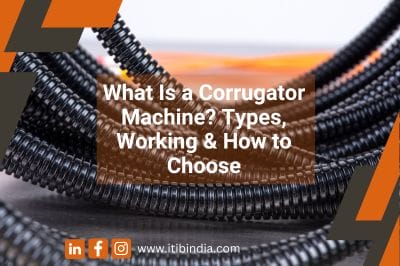
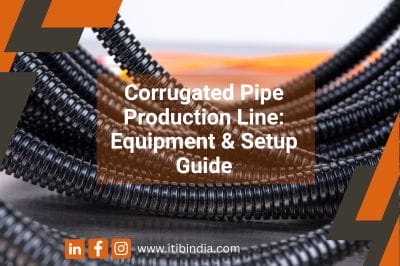
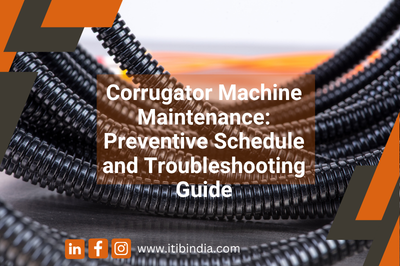
Each automobile producer follows a German or Japanese specification for its own car models. ITIB lines produce harness pipes from 4.5 mm I.D. up to 63 mm O.D., with the corrugation matched to the customer’s specification. Single wall construction gives the balance harness work needs: enough strength to protect the wiring, enough flexibility to route through the vehicle.
- Machine coverage: Form 15 series to 15 mm O.D.; Form 32 series to 32 mm O.D.; Form 65-54/74 to 65 mm O.D.
- Materials: PA for heat and abrasion resistance, and PP, per ITIB’s material guidance.
- Tooling: each OEM profile is a mould set; small diameters and uneven profiles call for the vacuum option.
Medical Tubes
The purpose of a medical tube production line is to make sure the producer meets hygiene and sanitation requirements. ITIB offers a complete turnkey solution for medical tubes with or without a cuff, in normal corrugation through to collapsible corrugation. EVA, which provides flexibility where the tube has to conform, and PE are the typical materials. ITIB does not publish a size range for medical tubing; the diameter is set by your product specification and then matched to a Form series.
Washing Machine Pipes
Inlet and outlet pipes are the core of the washing machine pipes segment. Demand comes from two directions: appliance OEMs and the replacement market. PVC and PP are the typical materials. Because PVC carries a higher rated output than PP on every single wall model – 115 against 65 kg/hr on a Form 32-52/72, for example (±10%) – material choice for this product has a direct effect on plant capacity.
Sanitary Pipes
Corrugated sanitary pipes serve bathrooms, washrooms and toilets – wash basin waste pipe, kitchen sink waste pipe, urinal waste pipe and other sanitary applications. PVC and PP are the typical materials, and the pipe is single wall. For the drainage side of the same product family, see advantages of corrugated pipes for drainage applications.
Tubing Applications Compared
| Application | What the line has to satisfy | Typical material | Wall | Size range (ITIB) |
| Harness pipes | German / Japanese OEM spec per car model | PA, PP | Single | 4.5 mm I.D. – 63 mm O.D. |
| Medical tubes | Hygiene and sanitation; with or without cuff; normal to collapsible corrugation | EVA, PE | Single | Per product spec |
| Washing machine pipes | Inlet and outlet pipe; OEM and replacement markets | PVC, PP | Single | Per product spec |
| Sanitary pipes | Wash basin, kitchen sink and urinal waste | PVC, PP | Single | Per product spec |
| Electrical conduits | Cable protection for residential and industrial wiring | PVC, PE | Single | 16 – 63 mm O.D. |
Typical materials per ITIB India’s material-to-application guidance.
Conduit is included for contrast; the complete line specification is in electrical conduit pipe making machine.
Configuring a Corrugators Machine for Tubing
- Moulds per dimension and profile. Dies and moulds are sized per pipe dimension, and each customer profile is its own mould set. Plan changeover tooling against the number of OEM sizes you will supply.
- Vacuum for critical shapes. Small diameters and uneven profile diameters need a vacuum system to hold shape – optional on V-range machines from 150/175 m³/h (Form 15 series) to 250 m³/h (Form 32-72/92, Form 65-54/74).
- Mould count for output. The Form 15-110 forms the same 4.5 mm I.D. – 15 mm O.D. range as the Form 15-70 but carries 110 moulds against 70, lifting rated PVC output from 33 to 53 kg/hr (±10%).
- Cooling. Single wall models run chilled water at 6–8 °C, at 2,000–3,000 L/h depending on model.
- Drying. Hygroscopic polymers must be dried before extrusion or moisture surfaces as voids and wall-thickness variation; the hopper drier is a fixed component of the line.
- Downstream. ITIB coilers handle 6–60 mm pipe at up to 300 rpm, with an optional connection to a cutting machine and a pipe-guide.
The component view of the corrugator itself is in essential parts of a single wall corrugated pipe machine.
Material and Output Planning for Tubing Lines
Rated output on ITIB single wall corrugators is published for PVC, PP and HDPE. PP and HDPE share the same rating on every model; PVC runs higher – from about 1.4× on the Form 15 series to about 1.9× on the Form 32-72/92.
No output is published for PA or EVA – typical materials for harness pipe and medical tubing respectively. Ask ITIB for a figure against your profile before modelling capacity, rather than borrowing the PP column. The material comparison is in PVC vs PP vs HDPE on a corrugator machine, and the kg/hr-to-metres method is in corrugated pipe production line capacity planning.
Running Several Tubing Products on One Line
Because the products overlap in diameter, one corrugator frame can serve more than one tubing family by changing dies and moulds. Three practices keep that efficient:
- Sequence production by material, not by order date, to cut purge and changeover time.
- Choose an extendable mould chain where growth is expected – Form 32-52/72 to 72 moulds, Form 32-72/92 to 92, Form 65-54/74 to 74.
- Set mould-cavity cleaning intervals against your actual material mix, as different polymers leave different residue – see the corrugator machine maintenance guide.
For the diameter map across every ITIB model, including double wall, see corrugated machine in India for small-diameter pipe.
Turnkey Supply for Tubing Lines
ITIB supplies tubing lines complete – raw material feeding, hopper drier, extruder, die head, corrugator, dies and moulds, and winders – with plant layout, installation, commissioning, operator training and after-sales support. The component-by-component scope is in complete turnkey solution for single wall and double wall corrugated pipes, and the line overview is on the corrugated pipe production line page. For ITIB’s full corrugator equipment range, including the corrugator pipe machine models covered here, contact India’s corrugator machine manufacturer directly.
Frequently Asked Questions
What are corrugators used for?
Corrugators form molten thermoplastic into corrugated pipe and tube. ITIB corrugators produce electrical conduits, automotive harness pipes, medical tubes, washing machine pipes, sanitary pipes, telecom ducts and drainage pipe.
Which corrugator is used for automotive harness pipes?
A single wall corrugator. ITIB harness pipe lines cover 4.5 mm I.D. up to 63 mm O.D., using the Form 15, Form 32 or Form 65 series by size, with corrugation matched to German or Japanese OEM specifications.
Can a corrugator produce medical tubes with a cuff?
Yes. ITIB offers a complete turnkey solution for medical tubes with or without a cuff, in normal through to collapsible corrugation, built to meet hygiene and sanitation requirements.
What material is used for washing machine pipes on a corrugator?
PVC and PP are typical. PVC carries the higher rated output on ITIB single wall corrugators – for example 115 kg/hr against 65 kg/hr for PP on a Form 32-52/72 (±10%).
Is corrugator output published for PA and EVA?
No. ITIB publishes rated output for PVC, PP and HDPE. Request a figure for PA or EVA against your specific profile before planning capacity.
Can one corrugators machine make several tubing products?
Yes, within its diameter range, by changing dies and moulds. Plan changeover tooling for each size and sequence production by material to reduce purge time.